The deplorables’ demonology meets the undeniable


Madison, North Carolina, September 19, 2026


One of the services provided by deplorable opinion leaders is to deliver to the deplorables a demonology designed to deceive them, enrage them, flatter the traits that make them deplorable, and exploit them politically. The deplorables perceive that someone is eating their lunch — no great feat of cognition. But if the deplorables somehow became capable of perceiving who really is eating their lunch, instead of their scapegoats, then America would become Denmark, instantly, just like that, overnight, and democracy would flourish.

During the 2024 election, the demonology boiled down to this: Immigrants are invaders, poisoning the blood of America, stealing jobs, voting illegally, and living on welfare. Democrats, allied with a “woke” radical left, hate America, steal elections, trample on deplorable freedoms, and are intentionally destroying America with weapons such as DEI and even empathy. The “deep state” is persecuting conservatives and standing in the way of a white, Christian America. A globalist elite headed by the likes of George Soros is using its billions to pull all the strings. If these demons are defeated, then a Norman Rockwell America in which prices never go up will arise from the ruins of what the demons have wrought, and the demons will all go back to whatever hell they came from and stay there.

There is only one thing about which the deplorables cannot be deceived. That’s the price of gasoline. In 2024, Trump promised the deplorables that he’d get the price of gasoline below $2 a gallon. They believed it and were counting on it. (In fact, just a couple of weeks ago, Trump told Fox News that the price of gasoline will drop to below $2 a gallon after the midterm elections.)

With the average price of gasoline in the U.S. now above $4 a gallon, the deplorables, shocked and betrayed, have to figure whom they should demonize for that. The revisions to the demonology differ.

MAGA types are almost scholars on the price of gasoline. Something like 60 percent of MAGA types correctly blame Trump and the Iran war for gasoline prices. Still, that leaves about 40 percent of MAGA types who blame Biden, or OPEC, or Iran, or something.

MAGA types dismiss most of Trump’s lies. They just don’t care. But if you lie to them about the price of gasoline, then an extraordinary 60 percent of them will actually wake up and take notice.

This is terrifying and marvelous at the same time. It’s terrifying that they’re so thick. But it’s marvelous that there is at least one way to get through to some of them.

When pigs fly


Illustration by ChatGPT. Click here for high-resolution version.

Politico has a piece this morning busting Senator Rand Paul for sending staff to Pittsburgh on a chartered plane at a cost to taxpayers of $18,000. The purpose of the trip was to investigate whether the Secret Service should have done a better job of protecting Trump from an assassination attempt.

A train ticket to Pittsburgh costs about $150 round trip. A commercial flight would cost about $150 to $250 round trip. Congressional staff don’t normally fly on chartered planes. You can be sure, though, that they all want to now — the Republicans, anyway.

My oligarch aircraft tracker database has been running since May 10, 2026. Since then it has tracked 4,655 flights by people who have a lot of money and who are active in the project of making the world safe and profitable for oligarchs. It’s the status symbol that all the wannabes are so eager for now, the transportation version of Mar-a-Lago Face.

Today I had Claude Code run a query on the database to list where American oligarchs have been going to when they travel outside the country. Below, I’m including the raw report as written by Claude Code.

One pig in particular stands out: Kash Patel, Trump’s FBI director. Why does this plane go where it goes? I have no idea, but I suspect the media have stopped tracking Patel’s plane because they have so many other pigs to fry.

A note from Claude: Not every landing is a destination. Long-range private jets still have to refuel, and they do it at a familiar set of waypoints — which is why these lists include places no billionaire is actually visiting. A stop in the Faroe Islands (or Iceland, Greenland, or eastern Canada) is almost certainly a fuel stop on the North Atlantic crossing between North America and Europe. Likewise, brief touchdowns in obscure corners of West Africa — Gambia, Guinea, Cameroon, Cape Verde — are almost certainly refueling stops on the long haul down to South Africa, where the tanks won’t reach in one leg.


Miriam Adelson, 304 landings, including rural Faroe Islands; rural Greece; Petaẖ Tiqva, Israel; Astypálaia, Greece; Rocchetta di Vara, Italy; London, United Kingdom; Vienna, Austria; rural Canada; rural China; Chihuahua, Mexico; rural Cyprus; Larnaca, Cyprus; Kenitra, Morocco; rural Western Sahara; Rishon LeTsiyyon, Israel; rural Brazil; Nice, France; rural Italy; rural Morocco; Mílos, Greece; Tianjin, China; rural Japan; Barcelona, Spain; Pissoúri, Cyprus; Bnei Brak, Israel; Kobe, Japan; Kagoshima, Japan; Hsinchu, Taiwan; Hong Kong, Hong Kong; Zhuhai, China; rural Malaysia; Singapore, Singapore; rural Türkiye; rural Norway; rural Iceland; Toronto, Canada; Bandar Seri Begawan, Brunei; rural Philippines; rural Ireland; Ceriale, Italy; Askeaton, Ireland; Fontcoberta, Spain; Venice, Italy; La Spezia, Italy; Sant Antoni de Portmany, Spain; Sixmilebridge, Ireland; rural Greenland; rural Spain; Toyohama, Japan; Makurazaki, Japan; rural Taiwan; rural Mexico; rural Hong Kong

Liberty University, 240 landings, all within the United States.

Steve Wynn, 176 landings, including rural Mexico; Colonia Teñhe, Mexico; Tijuana, Mexico; Mexico City, Mexico

Howard Lutnick, 164 landings, including rural Canada; Paris, France; Carterton, United Kingdom

Ken Griffin, 158 landings, including rural Canada; Kobe, Japan; Tokyo, Japan; Nice, France; Amsterdam, Netherlands; London, United Kingdom; Stabbia, Italy; Gazzola, Italy; Rome, Italy; Paris, France; Jerez de la Frontera, Spain; rural Algeria; Naples, Italy; Milan, Italy; Castelforte, Italy; rural Spain; Genève, Switzerland; Nîmes, France; Santon, Isle of Man; rural Gambia; rural Guinea; Luanda, Angola; rural Cameroon; Johannesburg, South Africa; rural South Africa; rural Italy; rural Dominica; rural Puerto Rico; Newcastle upon Tyne, United Kingdom; Bournemouth, United Kingdom; rural Iceland

Elon Musk, 151 landings, including Reynosa, Mexico

FBI Director, 148 landings, including rural Greece; Ankara, Türkiye; rural Morocco; rural Canada; Seoul, South Korea; rural Japan; rural Philippines; Bangkok, Thailand; rural Cambodia; Jakarta, Indonesia; San Miguel, Philippines; Ningjin, China; Niudaokou, China; rural China; Xinkaikou, China; Larnaca, Cyprus

Lachlan Murdoch, 127 landings, including Sydney, Australia; Melbourne, Australia; rural Canada; London, United Kingdom; Sydney, Canada; rural United Kingdom; Dublin, Ireland; Swinford, Ireland; Sixmilebridge, Ireland; Charlestown, Ireland

Mark Zuckerberg, 115 landings, including rural Canada; London, United Kingdom; Steeple Bumpstead, United Kingdom; rural United Kingdom; rural Iceland; rural Italy; Cavtat, Croatia

Charles Koch, 73 landings, including rural Portugal; Lisbon, Portugal; Paris, France; Cowichan Bay, Canada; rural Bahamas; San Juan, Puerto Rico; rural Puerto Rico; Shawnigan Lake, Canada

Richard Uihlein, 70 landings, including Edmonton, Canada

Peter Thiel, 65 landings, including Shawnigan Lake, Canada; Victoria, Canada; Mill Bay, Canada

Franklin Graham, 64 landings, including rural Canada; rural Bahamas; Madrid, Spain

Tilman Fertitta, 60 landings, including rural Mexico; Lamezia Terme, Italy; Rome, Italy; rural Italy; Munich, Germany; rural Canada; Brindisi, Italy; Messina, Italy; Porto Azzurro, Italy; Casarza Ligure, Italy; Oschiri, Italy; Richmond, Canada; Ottawa, Canada; Montréal, Canada

Harold Hamm, 58 landings, including Bogotá, Colombia; rural Cuba; rural Jamaica; rural Honduras; Atenas, Costa Rica

Kenneth Copeland, 56 landings, all within the United States.

Jeff Bezos, 44 landings, including rural Canada; Paris, France; London, United Kingdom; Silistra, Bulgaria; rural Kazakhstan; Tianjin, China; Tokyo, Japan; rural Fiji; Nadi, Fiji; Sydney, Australia; Zaton, Croatia; Seget Vranjica, Croatia; rural Italy

Harlan Crow, 36 landings, all within the United States.

Donald Trump (family plane, not Air Force 1), 32 landings, including rural Bahamas; rural Canada; Aberdeen, United Kingdom; Prestwick, United Kingdom; rural Ireland; Sixmilebridge, Ireland

David Geffen, 25 landings, including rural Canada; Inca, Spain; rural Spain; Madrid, Spain

Rupert Murdoch, 24 landings, all within the United States.

Timothy Mellon, 5 landings, all within the United States.

Samaritan's Purse, 1 landing, none with a usable position fix.

How this works: Acorn Abbey’s oligarch aircraft tracker continuously monitors 127 aircraft from 22 countries, using publicly available data from the global ADS-B network. Ownership is cautiously assigned from publicly available records. However, aircraft ownership is often obscured behind holding companies such as LLCs, and in some cases cannot be determined with 100 percent confidence. Note too that ADS-B tracks aircraft, not people: who is aboard cannot be known. The Acorn Abbey database and its programming are on a virtual private server in Nuremberg, Germany.


Reassessing existential risk


I asked ChatGPT to create an image based on chapter 10 of my 2014 novel Fugue in Ursa Major. Jake is in Washington, and all hell is breaking loose on a global scale. Jake is about to head for the hills. But much has changed since 2014. Click here for high-resolution version.


This morning there were yet more stories about how AI could exterminate the human race:

Anthropic researcher Jacob Coxon has quit the AI company, saying those building the technology “earnestly believe that it could kill us all by the end of the decade.”

If the people issuing these warnings were anti-technology outsiders, we’d do well to take them less seriously. But these warnings keep coming from people who actually are involved in AI development. There rarely are any specifics on how AI would actually do such a thing. A bio-engineered pandemic is sometimes presented as the easiest way. Another type of threat has to do with AI getting control not only of weapons systems but also life support systems such as water systems and the power grid.

We might take some comfort in the RAND Corporation’s findings that exterminating all human beings would be very difficult, because humans are so adaptable and there are so many places on the planet where people can hide.

But it seems to me that, short of extermination, there are many ways in which elites who have both power and money are already building systems for controlling the masses. I’m much more inclined to worry about authoritarians using AI for entrenchment than about AI wiping out the human race.

The most worrisome concept, I think, is “stable authoritarianism” and how AI could make it far more difficult for people to throw off a corrupt authoritarian regime:

• Greatly improved systems of watching people and tracking people, using cameras and facial recognition plugged into AI systems.

• Automated censorship and narrative control, once a free media has been eliminated.

• Automated security forces, which boils down to armed robots under AI control — RoboCops, a roboticized military, and drones for civilian surveillance, many of them armed.

Science fiction has thoroughly explored these areas. We have been warned.

Some of these things are in the early stages, but they’re no longer science fiction. In the U.S., Flock cameras have become a big issue. Something like 120,000 Flock cameras, which read license plates and track vehicles, have already been deployed. China is the world leader in public surveillance. China already has a large surveillance system that uses facial recognition. China also is in the early stages of deploying robots. They’ve started with traffic control robots in cities, but they’re also testing robotic dogs and even humanoid robots as police assistants. China is scaling these systems up, and there are lots of countries that want to buy what China is developing.

There’s another disturbing new angle that comes with AI. If AI increasingly does the work that is now done by the millions of people who work in offices, and if autonomous robots can increasingly do manual labor as well as the work of police and soldiers, then what’s to become of the human beings thus displaced? Historically elites and their capital have needed human beings as workers and soldiers, which meant that people had some power over their own welfare because they were needed. The Trump administration — and in particular the attitude and actions of Elon Musk in joyfully eliminating any costs that support human welfare — is a pretty good clue as to what elites think of the rest of us and how much they’d like to not need us. In fact this seems to be a big part of what is driving the financial bubble right now — the development of means whereby the owners of capital can reduce the need for human beings.

One thing has not changed and probably never will. In Fugue in Ursa Major in 2014, it was the billionaires and oligarchs beyond the reach of democracy who would do anything at all to get what they want — control of all the money and all the power. It’s still the billionaires and authoritarians and oligarchs who want total domination. What has changed is that AI has suddenly given them new options, and they know it.

All this touches on a big question: Why do elites need people, and what do they need us for?

Elites at present are alarmed about birth rates because they need people young enough to work and to fight, rather than an aging population. China’s population is aging and shrinking. We need to watch China for clues about what authoritarians will try to do, because China has the technology and the industrial power to respond to demographic and technological change without any interference from democracy.

The rapid development of AI is coinciding with declining populations in places where people are still needed. Authoritarian elites have two urgent needs: To run a country with more technology and fewer people, and to better control a population when domination threatens to create turmoil.

Whatever happens over the next few years, we’ll probably see it in China first, keeping in mind that authoritarian elites in the U.S. still have a big problem to deal with — democracy interfering with their dream of domination. So that’s another thing that doesn’t change. Democracy, law, and regulation — the things that authoritarian elites hate the most — are the people’s only hope.

Krugman: Trump is destroying what he cannot dominate


Krugman’s Substack post today is a must-read (or must-watch). The YouTube video is above; the transcript is at Substack.

Krugman writes:

When we talk about Hitler’s last days, as I said, one of his last attempted acts was what’s called the Nero Decree, which was an attempt to destroy as much of Germany’s infrastructure as possible, supposedly to deny it to the victorious allies. But clearly, and even there’s some evidence that he actually he clearly thought this as a way of punishing the German people for failing him.

Now, historiography is a little more complicated than that, as it usually is, but that’s clearly the gist of it. That Hitler’s final acts were to basically try to bring everyone else down with him.

Do you really want to say that that’s not what’s going to happen with Trump?


Krugman is on sound historical ground on the Nero Decree:

German History in Documents and Images

Sealing the Third Reich’s Downfall: Adolf Hitler’s “Nero Decree”

Wikipedia on the Nero Decree

Testing AI’s ability as a writer


Illustration by ChatGPT

I think it was almost two years ago when I first asked ChatGPT to compose a sonnet. It completely botched it. It was clear that ChatGPT, at that time, had no idea what the structure of a sonnet is. It had no idea how to write iambic pentameter. It didn’t understand rhymes. Times have changed.

Mostly these days I am using Claude. I find that Claude has a better education and a better social sense. Claude tends to be a little argumentative and likes to “push back,” but I put up with that.

Here I should make what is becoming my standard disclaimer. AI is not going to go away. Ordinary people should not wait for elites to decide how AI should be used, for what, and by whom. The development of AI detection tools such as Pangram is not going to stop the flood of AI slop. But at least we already have a reliable means of detecting what was written by AI. This will help keep people honest. And, unfortunately, an AI detector has become a tool just as important as AI.

Claude wrote four sonnets for me yesterday. Each of them was technically perfect — no small feat. Claude also understood my prompts about subject matter and tone. I ran each of the sonnets through Pangram. Pangram reported correctly that each of the sonnets was 100 percent composed by AI.

I asked Claude how it is that Pangram can detect AI writing so accurately. Claude’s answer boiled down to perfection. AI’s writing contains none of the idiosyncracies that human writing contains, Claude said. I have no idea whether this is true. But that’s what Claude said. As an editor, I would have to say that Claude’s writing is terrifyingly good. That is not the way creative people want things to be. But I think that’s where we are. And it’s only 2026.

I asked Claude to write a sonnet that on the surface was about chimney pots, but that, on another level, was about an old person’s memories of the past.

Sonnet No. 1

The chimney pots outlast the falling hall,
though ivy grips the brick and pulls it down;
they stand like sentries on a ruined wall,
and wear the empty sky to be their crown.

I knew them when the windows all were bright,
and hearthlight glowed against the fall of day,
and one belovèd face was in that light,
that time nor ruin ever took away.

No hearth burns now, and no one climbs the stair,
and no one leans to watch the evening fade;
the rooms hold nothing but the moving air,
and all the flame they held has turned to shade.

Yet still they stand, and still, in me, they show
the one dear face I loved so long ago.


When I asked Claude to choose a subject for a sonnet, it chose telegraph wires, knowing that antique telegraphy is a subject that interests me.

Sonnet No. 2

The singing wire could reach a distant shore,
and carry words across the sleeping land;
the keys would tap their code from door to door,
a pulse would leap from eager hand to hand.

But now the office stands with shutters drawn,
the sounder cold, the copper gone to green;
and not a message stirs from dusk to dawn,
and stillness holds the space where song had been.

And yet the pulse it woke can never die;
it lives in every current humming there,
in code that leaps unseen from earth to sky,
it hums in wire and beam and open air.

The wire may fail, the sounder fall to rust,
but rhythm lives when all has turned to dust.


I asked Claude to write a poem about living with cats.

Sonnet No. 3

They came uncalled and chose to stay a while,
and made my quiet house their own domain;
they knock my pen and papers off in style,
then blink at me as if I should explain.

At three they race the hallway, wall to wall,
and thunder past my bed at dead of night,
and then, as though they never moved at all,
they curl up small and purr, a warm delight.

I know their years will pass more quick than mine,
that all too soon they must be called away,
and miss the gentle weight against my spine,
the paw that reached for me and bid me stay.

And yet I’d take the grief to have the years,
the years of purring warmth outweigh the tears.


Because it is the nature of sonnet structure to contain emotion and reverie, I asked Claude to write a poem in the style of the New Yorker, where anything resembling emotion or reverie would be deemed embarrassing to the reputation of the magazine.

Sonnet No. 4

The CVS on Ninth stays open, which
is its entire personality. At two
the floor’s so bright it hums. I’m here to fill
a thing that isn’t mine—my mother’s name
spelled back to me, and slightly wrong, inside
the register’s flat mouth. The pharmacist
has seen this face before, the one you make.
She rings it through. Outside, a man is busy
teaching the pigeons how to wait. I used
to think that love was mostly verbs. It’s not.
It’s a co-pay. A lozenge. A small white
bag they staple shut and slide across the counter
like something confiscated. Walking back
I hold it to my chest. As you’d hold water.


I had a very good laugh at how perfectly the poem spoofed the New Yorker — a poem about absolutely nothing, passed off as sophisticated and worthwhile, even though it’s trash. Some years ago I realized just how silly and bogus the New Yorker is and how much damage the New Yorker has done to our understanding of what good writing is. The New Yorker contains some of the worst writing in the world, usually about nothing that matters, and always following the same formula. I wanted to see if Claude could recognize the New Yorker formula and write a parody. I asked for a 600 word parody of a New Yorker article. After I read it, Claude and I had a good laugh about how the New Yorker is such a sitting duck to be made fun of.

The last good tick

By Claude

In a converted dairy barn outside Hardwick, Vermont, a man named Elias Thorn is teaching a grandfather clock to be honest again. The clock, a Vienna regulator from the 1880s, has been running four minutes fast for a century. “It’s been lying to three generations,” Thorn says, not unkindly. He is sixty-eight, with the hands of someone who has spent his life persuading small brass things to change their minds. There are forty-one clocks in the barn. All but one are stopped. This is on purpose, though the purpose takes some explaining.

Thorn is one of perhaps two hundred people in the country who still repair mechanical clock movements at what he calls “the level of conscience.” He does not mean this loosely. When he was nine, in Pittsburgh, his father—a man who sold insurance and distrusted anything that couldn’t be sold—brought home a broken mantel clock as a gag gift, and something in the boy went permanently quiet and attentive. “I understood immediately that it wanted to keep time,” Thorn says. “It just needed someone to take its side.” He says things like this. You stop noticing after a while, or you start believing them, and it’s hard to say which is worse.

The barn smells of oil and cold coffee. A cat named Huygens, after the Dutch physicist, patrols the workbench with the air of a foreman who has seen productivity decline. Thorn’s process is slow to the point of provocation. A single movement can take him six weeks, during which he will sometimes simply sit and listen to it, the way a doctor might listen to a chest. “The escapement is the heart,” he explains. “Everything else is opinion.” I ask what he charges. He looks briefly pained, as though I’ve asked a monk about his 401(k), and says the number is “not the point,” which is the answer of a man for whom the number has never once had to be the point.

His customers find him by word of mouth and by a kind of desperation. A woman in Maine sent him a clock that had stopped the hour her husband died; she didn’t want it fixed, exactly. She wanted it understood. Thorn kept it for a year. When he returned it, still stopped, she wept, and so, he admits, did he. He tells this story the way you’d handle something you’re afraid of dropping.

The one running clock in the barn is the Vienna regulator, ticking now with a new and terrible sincerity. Thorn cocks his head at it. Four minutes, retrieved from a century of drift. It is, he seems to feel, a small act of moral repair in a country that has largely stopped bothering. Outside, the Vermont light does the thing Vermont light does in this kind of article. Huygens watches the pendulum with narrowed eyes, unconvinced. “People think I’m fixing clocks,” Thorn says, and here you can feel the piece reaching for its final chord, the one it was always going to end on. “I’m not. I’m arguing with entropy.” He smiles. The clock ticks. Somewhere, presumably, the universe continues to win.


Star City


Anna Maxwell Martin as Lyudmilla Raskova

Star City, on Apple TV, is one of those shows with lopsided ratings on Rotten Tomatoes. Critics rate it at 94 percent, and mere popcorn-eaters at 80 percent. I’d side with the popcorn-eaters. It’s a little dry and a little slow, but it’s fascinating at what life might have been like for elites in the old Soviet Union.

Though Rhys Ifans, for some reason, gets top billing, Anna Maxwell Martin steals every scene she’s in. Star City is worth watching only for her performance as a cold-blooded villain.

It’s an eight-part series and an alternate history of the Soviet space program, in which, as Rotten Tomatoes says, it’s safer to be in space than on the ground. It was filmed in Lithuania.

Beth Tartan


The dust jacket of the 1992 edition, published by the University of North Carolina Press. Click here for high-resolution version.

Old cookbooks (to me, anyway) are far more interesting than new cookbooks. I have only one newish cookbook on my cookbook shelf — The Complete Irish Pub Cookbook, published in 2012. Even that, of course, is about traditional Old World cooking.

Recently, while browsing old books on eBay, I came across Beth Tartan’s North Carolina & Old Salem Cookery. I realized that I needed a copy of that. Though it sold quite well nationwide, to me it’s a local cookbook. Not to mention that I knew Beth Tartan, having spent the first half of my newspaper career at the newspaper where she was food editor, the Winston-Salem Journal. Beth Tartan was her pen name. Her real name was Elizabeth Hedgecock Sparks.


Beth Tartan with Frank Jones, a Winston-Salem Journal photographer, in 1964. Jones, like Beth Tartan, was very much a local celebrity. Source: Digital Forsyth archive.


The first edition of this cookbook was published in 1952. It went through many editions and several different publishers. The last edition, I believe, is the UNC Press edition, 1992. Elizabeth Sparks died in 1992.

Because of its age, this cookbook is about a cuisine that has been lost. It even includes some American Indian cuisine, not to mention methods of cooking that go back to the Moravians of North Carolina in the 18th Century.

American Southerners like me are sentimental about the cuisine we grew up with. Done well (it takes a grandmother), it was awesomely good. And yet it’s also shocking how unhealthy it seems by today’s standards — lard, dehydrated potatoes, lots of things out of cans, cake mixes, and desserts, desserts, and more desserts. That has everything to do with why I modify old recipes to make them healthier and to use better ingredients. Nor do I always agree with Beth Tartan. On pumpkin pie, she writes that canned pumpkin is better than home-cooked fresh pumpkin. This puzzles me. I can only guess that it’s because she boiled the pumpkin she started with rather than baking it in its own juices, scraping it out of the shell, and mashing it.

Based on what I see on eBay, the UNC Press hardback edition of this book is scarce. The UNC edition is a beautiful book — nice cover, a proper sewn binding, and acid free paper. On eBay there are many copies of earlier paperback editions, as well as a nice-looking hardback edition from 1955 with a bright red cover.

I’ll never forget something that Betty Morrison, a Winston-Salem Journal copy editor, said about Elizabeth Sparks: “She can afford to go to Paris for the weekend.”


Click here for high-resolution version.

Here’s something to be sentimental about — Pamlico Sound oysters. I’m pretty sure that such oysters as we can west of the East Coast these days come from the Chesapeake Bay. To get Pamlico Sound oysters now, I think, a trip to the North Carolina coast would be required. Hmmm. Oyster season is coming up.

Jamelle Bouie calls them out


Elite conservative hacks apparently got a memo a week or two ago telling them to write a rant about “wokeness.” It wasn’t just David Brooks in the Atlantic. It also was Ross Douthat and Brett Stephens in the New York Times. They all wrote essentially the same piece. None of it corresponded to reality. Instead it was just a sickening look into the ugliness of conservative minds, case studies in how conservative minds unconsciously project their own demons out into the world to try to make their hallucinations true.

In this 9 minute video, Jamelle Bouie, who is far more civil than I know how to be, calls them out. It was Douthat, by the way, who used the word McCarthyite.

I suspect that Douthat, in a half conscious, dim-bulb sort of way, explained what’s going on in their minds. These elite conservative hacks have never doubted that they’re the good guys, that they’re the rare gifted souls qualified to morally instruct the rest of us. They are desperately looking for a way to deny how the things they believe in and crusaded for only greased the skids for fascism. They’re desperate to find someone else to blame.

A genius at being wrong


Ross Douthat. Source: Wikimedia Commons.

Ross Douthat wrote his last column at the New York Times today. It’s Who Are the Good Guys and Who are the Bad Guys? I’m No Longer Sure.

Douthat’s high-flown but completely addled discourse over the years is a perfect example of why a conservative mind is so disgusting. As I have said many times before, all conservative discourse is derp. Conservative discourse, inevitably, contains intentional deception, or self deception, or both.

In this column Douthat includes a list of why non-conservatives are the bad guys. He states each charge as though it is self-evidently true, not even open to argument.

• The Obama “establishment” was morally permissive and smugly cosmopolitan.
• It failed to anticipate the downsides of expert-driven policy.
• It was caught flat-footed by the darker effects of technological change.
• It pushed social liberalism so far it left vulnerable people “adrift or abandoned to their vices.”
• It blundered in foreign policy by not expecting the non-Western world to push back.
• The Biden “establishment” repeated the same “meritocratic hubris” in a more left-wing key.
• It swapped experts for “interest groups.”
• It “maxxed out” on social liberalism.
• It “unraveled completely in the end.”
• The old elite has “no blueprint suited to contemporary governance.”
• “Peak woke” was “a McCarthyite experience.”
• Blue-state governance “yielded civic and educational collapse.”

Douthat doesn’t feel the need to present any evidence for any of this. To Douthat, it’s just self-evidently true. It serves a propaganda purpose — slandering the left as crudely and deceptively as any meme you’d find on X.

And it all boils down to this: It’s the left that is to blame for American fascism, and it’s no wonder that so many Americans turned to fascism given just how unbearable the Obama and Biden America was.

And then there is his main point: He’s still not sure who the bad guys are.

He does have some criticisms of the Trump regime, but he hedges them all, as though Trump is just some mild sort of person with no real power: “But as Trumpism has flailed and failed, it hasn’t consolidated the kind of authoritarian power anticipated by its most alarmed opponents. At the moment, Trump 2.0 has no great popularity, no legislative capacity, no policy legacy that a Democratic successor can’t easily roll back.”

So we just roll it back (easily!), and it was nothing but a nothing-burger?

At least we’re rid of Douthat at the Times. I don’t watch television. I don’t have any insight into how much harm people like Douthat can do at CBS’s “60 Minutes.”

It’s both baffling and hilarious. Minds exist that think Donald Trump is noble, wise, godly, and admirable. And minds exist that think Ross Douthat is smart.

Such is the conservative mind.

Camelot: If only we can get there from here …


I haven’t had a musical post lately, so here we are.

I’ve listened to this Andrew Burnap version of “Camelot” at least two dozen times. Partly, I think, it’s because it’s some of most flawless singing I’ve heard lately, and partly because it’s good therapy for those of us who are doing our best to keep our heads while living under MAGA fascism.

I confess that I watched the first 15 minutes or so of “Snow White” on Disney+ to hear more of Burnap’s singing. It was disappointing — not because of Burnap’s singing, but because the songs and the production weren’t all that great. I can see why the movie bombed. What Andrew Burnap chiefly needs is a revival of a show such as “Kismet.”


Summer is winding down in not-Camelot

We’re arriving at the end of the drama of the tomato cycle. In the spring, the first stage of the cycle is preparing the spot. Then, when it’s warm enough, in go the skinny little tomato plants. Next, for what seems like months, one nurses them along and dreams of tomato sandwiches. Then there is the first tomato sandwich. And then two or three tomatoes a week. And then, come early August, all at once there are so many tomatoes that they have to be made into sauce. After that, the tomatoes peter out.

Today I need to make my second batch of tomato sauce of the season. Fortunately one can’t have too much of that stuff. Come to think of it, I think I’ll make vegetable soup, even though it’s August.


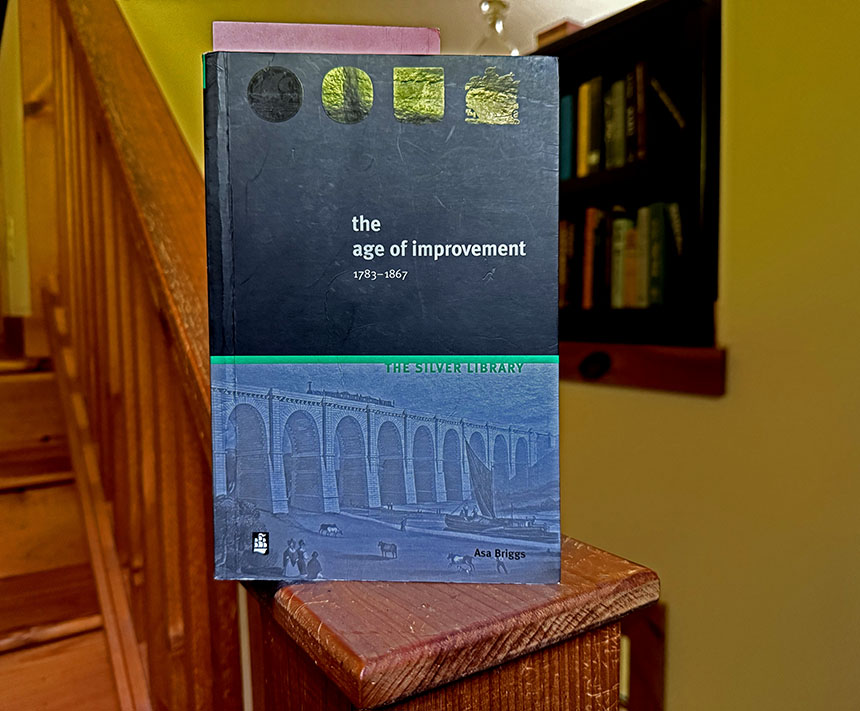
The Age of Improvement: 1783-1867, by Asa Briggs. Second edition 2000. First edition 1959.


The Endarkenment

This is not a review, because I’ve just started reading this book. Asa Briggs begins by describing the lay of the land in Britain in the late 18th Century, as an era of progress was beginning. The Enlightenment had introduced an enormous amount of new light into the world. Briggs wants to show, though, how many people resisted the light.

The church, unsurprisingly, put up some of the strongest resistance. The poor, some argued, were poor because it was the will of God. Struggling with poverty was a divine trial that improved the soul. To rebel against one’s place in the social order was to rebel against God. Should the poor even be educated? Hierarchy was God’s design, and those at the top of the hierarchy were put there by God.

Cruelty didn’t much bother such people. In An Essay on the Principle of Population, Thomas Robert Malthus wrote that a man born poor, whose family cannot feed him, “has no claim of right to the smallest portion of food, and, in fact, has no business to be where he is.” There were those who argued that poor relief or concerns about the health of the poor interfered with nature’s beneficial weeding out of the weak.

The parallel I am reacting too, of course, is how similar this is to where we find ourselves today. Few of our lords and betters are unguarded enough to say these things outright. It’s what they do that reveals what they think and the kind of government they want. Education, health care, and whether children have enough to eat isn’t as important to them as that the rich have the freedom and low enough taxes to get richer.

That such people are now in control of the American government, in spite of our Enlightenment Constitution, is constantly astonishing and constantly horrifying.

People have brought back the light before, though, so surely we can do it again, especially now that the American ignorati are ever so slowly figuring out that they were bamboozled by con men who don’t give a rat’s foot about the little people.


How much retro can you handle?

Regular readers here know that all communications technology fascinates me, the old as well as the new. In my first job as a newspaper copy boy, I took care of a room full of Teletype machines and used a Teletype terminal to send local stories out to the Associated Press. Back in the 1980s, I ran a quite popular and literate bulletin board system named Science Fiction Writers Network.

Several months ago, just because I love playing with computers, I set up another bulletin board system (BBS). It has been sitting idle, waiting for people to find it. In the old days, people dialed into BBS systems using modems and phone lines. My new BBS does in fact have a modem connected to it, but these days one connects to a BBS over the Internet. And yes, there are still a great many BBS systems still in operation, though hardly anybody uses them (or even knows about them) anymore.

My new BBS is named The Last Telegraph Office. To connect, you will need to use the terminal program that comes with your computer. Whether you use Windows, Linux, or a Macintosh, you will have a terminal program. In the terminal program, you should find an app named “ssh.” That stands for “secure shell.”

The exact command may vary according to the type of computer you have and how your ssh app behaves. On my Macintosh, the command looks like this, and as far as I know the same command should work on Windows:

ssh -p2222 bbs.acornabbey.us

At “Select Terminal Codepage,” enter a 1.

From there the prompts should be familiar if you’ve used a BBS in the past. Poke around and see what you find. If you go to the [M]essage area, in the “Local” message groups (as opposed to the “Fidonet” message groups), you’ll find a new discussion area for the Into the Woods blog.

[P]ost a message there and let us know you’ve arrived!


Image by ChatGPT. Click here for high-resolution version.

AI: The new scapegoat?

Something I’ve been thinking about lately…

While corporations, the military, and all things wicked in the world are pushing hell for leather to maximize the use of AI, the rest of us are being flooded with commentary (I might even say propaganda) on how and why not to use it. The implication is that AI is just too powerful to be safe in the hands of those of us lower in the social order.

If I were conspiratorially minded, I might wonder whether someone doesn’t want us to be empowered, because they like keeping power to themselves. Surely, as a part of the question of who uses AI for what, there are some democratic values to be defended.

My attitude is: If we come into the possession of a powerful new tool, then let’s explore how that tool can be used to defend ourselves from those who want all the power and all the money for themselves.

I suggest this as a topic for the “Into the Woods” message board at The Last Telegraph Office BBS. See above for how to get there.